
By Naldo Neto, IRATA Level 3 and licensed painter · Updated October 2026 · 3 min read
Key takeaways
- Both methods are safe when done properly; they suit different jobs.
- Rope access sets up in hours from roof anchors; scaffold takes days to weeks.
- For painting, repairs, sealing and cleaning on most buildings over two storeys, rope access is usually cheaper and less disruptive.
- Scaffold still makes sense for heavy work across a whole elevation over a long period.
When a strata committee or building manager gets quotes for façade work, the first big decision is usually how the trades will reach the wall. For buildings over two storeys the choice is mostly between scaffolding and rope access. Both are safe when done properly. They suit different jobs.
How each method works
Scaffolding is a temporary structure built against the building, level by level, with working platforms at each lift. It needs to be designed, erected by licensed scaffolders, inspected, often wrapped in shade cloth, and later dismantled. On a footpath it usually needs a council permit and a hoarding.
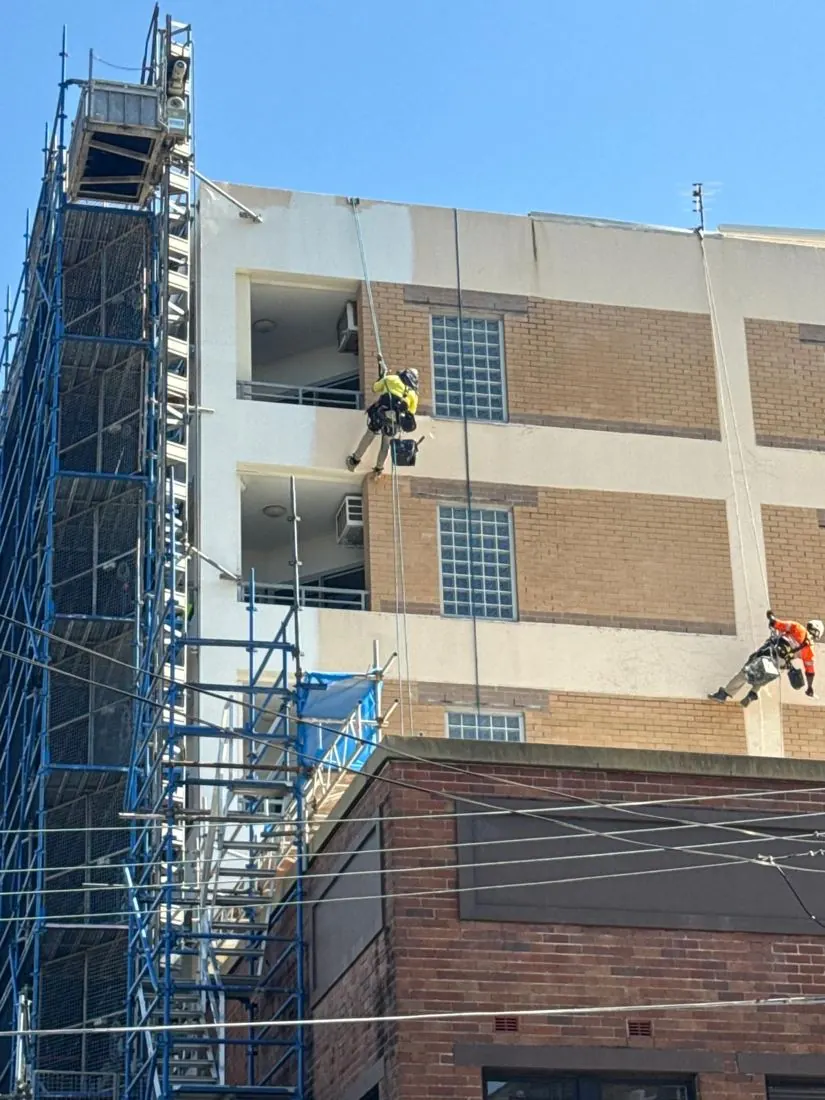
Rope access uses two ropes per technician, each fixed to its own certified anchor on the roof. The technician descends the façade in vertical "drops" and does the work as they go, then the ropes are moved to the next drop. Under the IRATA system every job is supervised by a Level 3 technician and has a rescue plan.
| Rope access | Scaffolding | Boom lift or EWP | Swing stage | |
|---|---|---|---|---|
| Set-up time | Hours: rigged from roof anchors on the day | Days to weeks to erect and dismantle | Hours, but needs ground access and level hardstand | A day or more to install the davit or roof rig |
| Ground footprint | Small exclusion zone at the base | Full perimeter, often over footpaths and gardens | Large base area near the wall | Small, but needs a suitable roof structure |
| Height reach | Any height with suitable anchors | Any height, cost rises with every lift | Limited by the machine, typically low to mid-rise | Any height with a suitable rig |
| Disruption to residents | Low: no structure across windows or balconies | High: blocked light, access and security risk | Medium: noise and ground disruption | Low to medium |
| Best for | Painting, repairs, sealing, cleaning and inspections on most buildings | Heavy work across a whole elevation for a long period | Low-rise work with good ground access | Long runs of glazing or very repetitive work |
| Main cost driver | Labour time on the rope | Hire, erection, permits and time on site | Machine hire and operator | Rig installation and hire |
General guide only. The right method depends on the building, the work and the site. We also arrange boom lifts, swing stages or scaffold where a job needs them.
Cost
On a scaffold job, you pay for the scaffold before any work is done: design, delivery, erection, inspections, hire for every week the job runs, and dismantling. On a mid-rise building that can be a large share of the total price.
Rope access has almost no set-up cost by comparison. A crew can rig from the roof anchors and start working the same morning. The saving is biggest when the work is spread out (repairs scattered across a façade), short (a few weeks of painting), or high (where scaffold gets more expensive with every lift).
Where scaffold can come out ahead is heavy work that covers an entire elevation for months, such as full re-cladding or major structural replacement, where many trades need a platform at the same time.
Time to start and finish
Scaffold has to be booked, designed and erected before work starts, and taken down after. That can add weeks to a project. Rope access crews can usually mobilise within days of approval, and the job finishes when the work does.
Disruption to residents and tenants
This is often the deciding factor for strata buildings. A scaffold covers every balcony and window on the elevation for the whole job, reduces light, raises security concerns and stops residents using their balconies. Rope access technicians are beside each unit for a few hours at a time, and there is nothing left on the building overnight.
At ground level, rope access needs only a small exclusion zone at the base of each drop rather than a hoarding over the footpath or driveway.
Safety
Both methods have strong safety records when run properly. Rope access relies on trained technicians, two independent ropes, certified anchors and a supervisor responsible for rigging and rescue. Scaffold relies on correct design, erection and inspection. The questions to ask either contractor are the same: who supervises, what is the rescue plan, and are the anchors or scaffold certified?
Which jobs suit rope access
- Repainting multi-storey buildings
- Concrete cancer and render repairs scattered across a façade
- Sealant and expansion joint replacement
- Façade washing and window cleaning
- Inspections and defect surveys
- Anchor and height safety installation
When scaffold may still be better
- Full re-cladding or replacement of large façade elements
- Heavy structural work needing many trades at once over months
- Buildings with no safe way to install roof anchors
A good rope access contractor will tell you if your job is one of these. We would rather recommend scaffold than take on work that rope access doesn't suit.
The bottom line
For most painting, repair, sealing, cleaning and inspection work on Sydney buildings over two storeys, rope access is cheaper, faster to start and far less disruptive. Ask for both options on bigger jobs, compare the total cost including access, and check the supervision and insurance behind each quote.
If you'd like a second opinion on a scaffold quote, send it to us with a few photos of the building and we'll tell you whether rope access could do the job.
Sources and further reading
- IRATA International: rope access training and the International Code of Practice
- SafeWork NSW: managing the risk of falls at workplaces
- Standards Australia: AS/NZS 4488, AS/NZS 5532 and AS/NZS 1891.4
- NSW licence check: verify any contractor's licence
Questions
Is rope access cheaper than scaffolding?
For most façade painting, repairs, sealing and cleaning on buildings over two storeys, yes, because there is no scaffold to hire, erect, inspect and dismantle.
Is rope access as safe as scaffolding?
Yes, when it is done under the IRATA system with trained technicians, two independent ropes, certified anchors and a Level 3 supervisor.
Can rope access be used on any building?
Most buildings, as long as there are safe anchor points on the roof or they can be installed. Very heavy structural work may still need scaffold.

About the authorNaldo Neto leads Tactical Height Solutions. He is an IRATA Level 3 rope access technician and licensed painter with a background in rendering and remedial work on Sydney buildings. More about Naldo.